Showing posts with label talk. Show all posts

Monday, 30 January 2012

Event report: Philip Satherley - 'The Case for Assisted Dying'

Time: 19 January 2012, 19:00-21:00
Place: Ramsay LT, Christopher Ingold Building, University College London

We invited Philip Satherley, the Research and Policy Officer of Dignity in Dying (DiD), to give a talk on assisted dying.


DiD is a UK organisation campaigning for the legislation of assisted dying for terminally ill, mentally competent adults. They work alongside Compassion in Dying, a partner organisation focused on informing and supporting terminally ill individuals concerning their current choices and rights at the end of life.

To introduce the topic, Satherley sought to clarify what is meant by assisted dying, and its definition relative to similar concepts:
  • Assisted dying applies to terminally ill, mentally competent adults who are medically deemed to have less than 6 months to live; and who have met strict criteria and safeguards, including psychological tests. This involves the patient receiving life-ending medication, which they will self-administer at their own will - quite often this is done at a very advanced stage in their terminal illness. Assisted dying is practiced legally in Oregon and Washington. 
  • Assisted suicide applies to not only terminally ill individuals, but also chronically ill and disabled individuals who wish to receive assistance to terminate their life. This is legalised in Switzerland. 
  • Voluntary euthanasia allows a medical doctor to administer life-terminating medication - usually injection - directly to the patient. Strict safeguards and tests are still undergone. Voluntary euthanasia is practiced in the Netherlands and Belgium. 
  • Non-voluntary euthanasia applies to cases where the patient has lost all mental capacity, yet a third-party administers life-ending medication without the explicit consent of the patient. This is not to be confused with involuntary euthanasia, which is when euthanasia is performed against the will of the patient. While illegal all across the world, non-voluntary euthanasia is practiced in the Netherlands under the Groningen Protocol.
Satherley stressed that DiD campaigns for assisted dying only, specifically addressing critical safeguards such as appropriate mental capacity, 18 years of age, the patient having a terminal illness and voluntarily and repeatedly having requested assisted dying.


Two examples of personal stories illustrate the types of cases DiD works with:
  • Waltraud Coles: Waltraud's husband wrote to DiD telling them about his wife's struggle with advanced secondary progressive multiple sclerosis. Due to excessive fatigue and severely limited mobility, severe side effects from partially effective pain relief, and an onset of pneumonia, she self-terminated her life by refusing all foods and water for 19 days. Her last words were: "Society is making me die in this abysmally cruel way. Society is anybody who cannot be bothered to lift one single finger to change this (current) inhumane law, and thus give completely helpless people like myself, in the very advanced phase of a degenerative illness, no other legal option (than starvation) when we want to end the unbearable daily ordeal which is all that is left of our 'life'."
  • Geraldine McClelland: A member of DiD, Geraldine contacted the organisation when she was informed of her terminal illness - lung and liver cancer metastasised from breast cancer. On the day of her death, she wrote a letter to DiD, detailing her actions and what she believed needed to be changed in UK legislation regarding assisted dying. Her condition, which involved serious breathing problems, had confined her to her home. She wanted the option to take life-ending medication to terminate her life surrounded by friends and family. However, as UK laws prevent this, she travelled to Dignitas, an assisted dying organisation in Switzerland. As she could not die in her own country, she pleaded for the UK laws to be changed such that other people would not need to travel abroad in order to die. 
Importantly, and also expressed by Waltraud Coles, Geraldine believed loved ones should not be in a position of breaking the law in such situations. Debbie Purdy, suffering from multiple sclerosis, won a significant case through the House of Lords where she succeeded in arguing that the partner of a terminally ill patient should not be prosecuted when accompanying them abroad for assisted dying.

Satherley proceeded to summarise why DiD strongly believes laws should be changed to allow assisted dying in the UK:
  • Personal autonomy: as Sir Patrick Stewart, one of the patrons of DiD, put it - "We have no control over how we arrive in the world, but at the end of a life we should have legal control over how we leave it."
  • Research from Oregon: approximately 40% of patients receiving life-terminating medication choose not to use it, but consider the option a great comfort or an 'insurance policy'; most patients are well-educated, medically insured (i.e. no financial difficulty), had no prior disabilities or mental illness, and had cancer as the underlying cause of illness; and while some had symptoms of depression, all patients receiving assisted death had full mental capacity and were able to make rational decisions. 
  • Opinions of the general public: the 2010 British Attitude Survey (BAS) found that 82% of the general public supported assisted suicide, and the 2008 BAS found that 80% supported assisted dying. 
  • Opinions of religious people: breaking down the survey between religious and non-religious people, the 2010 BAS found that 92% of non-religious people supported assisted dying and assisted suicide, while 72% of religious people did the same.

One important question that was raised during the following Q&A session was why DiD campaigns for assisted dying, specifically, and not the other forms of euthanasia. Satherley stressed the importance of having safeguards in place, e.g. ensuring that the patient has a terminal illness, and not a chronic illness or disability which may be open for improvement of life quality. Moreover, DiD believes it is essential that physicians are involved as there are problems with taking the procedures out of the medical system; and that voluntary euthanasia ultimately takes the final decision out of the hands of the patient by - to an extent - forcing the practitioner to end an individual's life. 

DiD campagins for what the UCLU ASHS believes is a very important cause, and they are always looking for people to get involved. If you want to join the campaign, they can be found on Facebook and Twitter.

Event report: Keith Porteous Wood - 'Religious Threats to Equalities'

Time: 12 January 2012, 19:00-21:00
Place: Harry Massey LT, 25 Gordon Street, University College London

UCLU ASHS welcomed Keith Porteous Wood, Executive Director of the National Secular Society (NSS) to give a talk on the special privileges and exemption from laws given to religious people in society. Having been in his current position since 1996, Wood leads the NSS in lobbying the UK government and Parliament, focusing on universal equalities and human rights. While his job description is to promote equalities and human rights, Wood began his talk saying he is actually fighting religion all of the time, 'so often it's religion that's the problem.'

Wood gave several examples of cases he had dealt with in his work throughout his talk, to illustrate the manner in which religious bodies claim exemption from various codes of conduct. These include the disadvantages faced by teachers in faith schools, the vast majority of whom are not religious, yet work in schools whose authorities can legally employ and dismiss qualified teachers on the basis of their religious beliefs. Similarly, the NSS has been involved in cases of individuals being discharged from job positions on the basis of their sexual orientation. While such instances angered Parliament, the Blair government at the time (2003) let these cases pass  - which 'gives an idea of exactly how much influence religion has in government.' The cumulative effect of having had religious Prime Ministers almost exclusively for the past 30 years is huge.


To further illustrate the kind of fights and their scope the NSS has to encounter, Wood described a case under the Brown government, whereby it was stated there should not be any concessions in VAT for religious places of worship. Wood and the NSS wanted this to be generalised to all public places - however, this request was rejected. It was not until Wood wrote an appeal to Brussels, that the UK government finally gave in. The work of the NSS spans broad horizons, then, as there interventions at a European level and occasionally in the UN. Although the Fundamental Rights Agency has been set up under the EU to look into human rights issues around Europe, tied to e.g. immigration and homophobia, Wood argued that a fundamental problem is the immense power of churches: their historical roots coupled with well-developed and well-funded networks of people part of a large hierarchical organisation, make the fight for human rights and equalities particularly challenging. To illustrate this, he described an episode during one of his visits to the headquarters of the European Commission - purposed to be a secular organisation - where he witnessed a male secretary greet a visiting bishop by kissing his ring.

Another fundamental problem, is the heterogeneity of the religious population: as many religious people are rather liberal and secular, there is a huge mismatch of democracy that religious representatives have so much power. This illustrates a worrying misrepresentation of the religious population. Indeed, in his conclusion of his talk, Wood argued that the entire religious make-up of the country is changing. Roughly 7% of the population go to church on a regular Sunday, at a rate that is constantly dropping, while the average age of church-goers increase at a meteoric rate. Considering this, it is 'absolutely bloody terrifying what they [religious bodies] can do because of their noddy religious status.'

Saturday, 5 November 2011

Event report: Paolo Viscardi - "Myths, Memes, & Misidentifications"

Time: 03 November 2011, 19:00 - 20:30
Place: Ramsay LT, Christopher Ingold Building, University College London

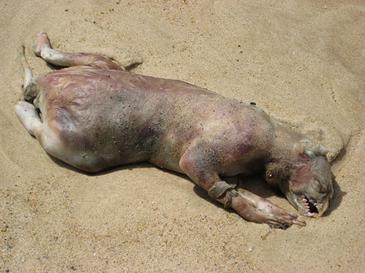
UCLU ASHS gathered on this rainy Thursday night for a talk on mermaids, the Montauk Monster, and Japanese Monkeyfish, amongst other dubiously existing creatures introduced to us by Paolo Viscardi. As a natural history curator at the Horniman Museum in South London, co-founder of London Science in the Pub, and administrator of askabiologist.co.uk, Viscardi presented numerous examples from both history and his own experiences of the evolution of myths, memes, and misidentifications in society, demonstrating how "members of the public are freaks."

With an educational background in biology and geology, Viscardi applies his knowledge of fossils and bones in his work at the Horniman Museum. As such, he frequently receives inquiries from laymen finding ambigious-looking objects around the country requesting their identification (or confirmation of wacky suspicions, rather), of which he listed several examples: a concreted sea urchin believed to be a dinosaur egg; the all so familiar random toast burns believed to be the manifestation of Jesus and its Muslim equivalent; the Pope in a fire; and the 'polar bear' washed up on the beach in Cornwall. These are all examples of pareidolia, people's tendency to assume things are 'super freaky' because it looks different or has certain features, reflecting the intrinsic human ability to search for and attribute meaning to ambiguous stimuli. When taken to the extreme, pareidolia can also reflect human idiocy, as it were, exemplified by the case of the man who was so convinced the piece of rock he had found was a dinosaur egg containing an embryo, that he kept it for over 20 years and staked his entire retirement on it.

The Montauk Monster, in particular, is a case of mistaken identity which received widespread attention. A 'weird alien monster creature with a beak' washed up on the shore of Montauk, spawning a cult movement including Montauk Monster artwork, websites, origami and Montauk Monster on toast, before the truth was finally revealed as retold in this video. Instead of indulging in this the hysteria of pareidolia, Viscardi urged us to look at the Monster's teeth, as teeth are very good indicators of the species. Showing us images of the Montauk Monster's skull next to four comparable skulls of North American mammals, the audience unanimously correctly identified the Monster's skull as that belonging to a raccoon. Its carcass had been in water for such a long time that it had lost all its fur, thus giving it its otherwordly appearance.

Viscardi described further examples of such mistaken identities and manufactured monsters. Travellers, including Christopher Columbus, encountering the then unfamiliar species of manatees and dugongs, would often think they were mermaids. Stories of mermaids have been around for thousands of years, and there is a large body of folklore and myths surrounding these mythological creatures. Naturally, then, sailors knew much more about mermaids than manatees and dugongs. This, coupled with likely mental disturbances, such as hallucinations, caused by long travels, would lead the sailors to believe these squishy creatures were mermaids.

It goes without saying that the phenomenon of pareidolia can easily be exploited for personal gain. Mermen, or Japanese Monkeyfish, were believed to be manufactured by sewing the upper half of a monkey to the lower half of a fish. P.T. Barnum was a notable scam artist who in the mid-1800s misrepresented the so-called 'Fejee Mermaid' with a rich 'background story', 'verification' of authenticity by a 'Dr Griffith' and clever manipulation of newspaper journalists. This caused great uproar among the public, generating substantial sums of money for Barnum. Years later, a Japanese Monkeyfish arrived at the Horniman Museum. CAT scans, x-rays and other examinations revealed the 'part fish, part monkey' to be constructed by a piece of wire, some pieces of wood, a bundle of fiber, some fabric, clay, papiermaché and some fish bones.

In conclusion, then, 'always check your facts, otherwise you'll end up looking like an arse.' Also, there are lots of weirdos out there.

Check out Viscardi's blog for Friday mystery objects or visit the Horniman Museum (supposedly wonderful in the summer for picnic with mates!).

Tuesday, 11 October 2011

Event report: Andrew Copson - ‘Objections To Humanism’

Time: Thursday 6th October 19:00-21:00
Place: Darwin Biochemistry lecture theatre, Malet Place, University College London


For the first event of the academic year the society hosted a talk by Andrew Copson, Chief Executive of the British Humanist Association (BHA) titled ‘Objections to Humanism.’ Andrew became Chief Executive of the British Humanist Association in January 2010 after five years coordinating the BHA's education and public affairs work. His writing on humanist and secularist issues has appeared in The Guardian, The Independent, The Times and New Statesman as well as in various journals and he has represented the BHA and Humanism extensively on television news on BBC, ITV, Channel 4 and Sky, as well as on television programmes such as Newsnight, The Daily Politics and The Big Questions. He is a former director of the European Humanist Federation (EHF) and is currently a Vice President of the International Humanist and Ethical Union (IHEU).

Andrew began by pointing out that being aware of the objections raised about humanism enables those who are humanist to be better armed to counter those criticisms raised, he also continued by saying that it is an obligation to be self-critical of one’s own world view including a humanist world view. Andrew went on to structure the talk on the basis of each criticism and how these should be addressed individually, the first being:

1. It diminishes the dignity of humanity.
Andrew points out here that essentially people are arguing that if we accept the evidence that people are nothing more than animals then how are we to act in any other way. His response consisted of the fact that just because we do not like the fact that we are animals it does not change it, being animals does not make us bestial.

2. Humanists can have no morals.
Here he gave an anecdote of a train journey back from a conference detailing his conversation with a priest, in which the priest could not believe how without religious dictate someone ‘wasn’t a rapist.’ Despite the raucous laughter in the room this and similar questions are often faced by many non- religious people. Clearly in response Andrew points out how this is a very bleak and false view of humanity, morals are not given by god, morality is an evolved system we use to coexist peacefully and sociably.

3. Too dry, too rational.
An example he uses is that often people argue that science cannot explain love. He counters this point by suggesting that science is the way to understand much because it is rational, universal and enquiry based, and that science can also be an inspiration.

4. It isn’t the way to explain everything.
In this rebuttal he states that explanations enhance but do not diminish, and that science’s remit is not to answer all the questions but to understand that which we can know.

5. A secular religion or “your pope Richard Dawkins.”
In response to this he describes the major tenets and concepts behind humanism as a movement, in doing so he explains how humanism is a collection of ideals and beliefs that have always existed in society. You cannot be a Christian without ever hearing of Christ, but you can be a humanist without ever hearing of humanism; as humanism describes an implicit belief system that already exists, the beliefs and values are as old as human history and are a permanent alternative.

6. A myth of human progress.
It is pointed out here that humanists are criticised for being too optimistic with an unwarranted sense of utopianism. Andrew talks about how we should be looking cautiously on the bright side, citing the BHA bus campaigns as an example. He also suggests that if you don’t believe in external help then you have to believe that normal men and women will do something, which makes progress more likely.

7. The pointlessness of it all or Nihilism.
To this idea Andrew calls the idea of the universe being meaningless a vain and ludicrous position. He also accepts here that from this perspective people often bring up a fear of death, but he suggests that death is something we should accept and live our life in accordance with reality.

8. What do you mean “that is all there is?”
He begins addressing this point by stating, what do you mean ‘all’? He adds that in making such statements you run the risk of undervaluing all that is here and now, in life the meaning comes in living, emphasizing the one life we have to live principle of humanism.

From Andrew concluding on the merits of the principle of having one life to live, the talk moved to a Q and A with members of the audience. Questions ranged from asking whether he altered his talk depending upon the audience being hostile or a ‘preaching to the choir situation’, Gaia theory, whether truth should be valued above all else, how best to enlighten your religious grandma (A C Grayling being suggested by Andrew) and how one could have hope knowing that people know right from wrong but do not always implement it. Andrew graciously continued the debate in the Jeremy Bentham pub afterward where as usual the conversation extended to various related and non-related topics. We would like to thank both Andrew Copson and everyone who attended the talk in making our first event of the new academic year a huge success.

If you would like to know more about humanism or become a member of the BHA there is a wealth of information at the BHA website: http://www.humanism.org.uk/home

Saturday, 12 March 2011

Event report: Paul Sims - "Is there any point in talking to believers?

Time: 2 March 2011

Place: Bentham Seminar Room 3, Bentham House, UCL


UCLU ASHS hosted a talk by Paul Sims on the topic, "Is there any point in talking to believers?" Paul Sims is the News Editor of New Humanist Magazine, published by the Rationalist Association since 1885, and runs the New Humanist blog. His magazine features have explored topics ranging from Islamic extremism to creationist zoos.


Sims introduced the talk by expressing his personal opinions on the public reaction to the four-day Papal visit to England and Scotland in September 2010. Acknowledging that the Vatican does have much to answer for regarding the allegations of child abuse, he deemed the debate surrounding the visit "hysterical" and "over-the-top." In particular, he criticised Richard Dawkins' speech at the Protest the Pope rally, during which Dawkins considered the Pope "an enemy of humanity." Sims questioned what is actually achieved when an atheist spokesperson such as Dawkins publicly expresses aggressive atheism to this extent, fuelling anti-religious hostility amongst the public. Must secularism and religion be framed as a battle between two camps? On the contrary, Sims stressed that reasoned debate between individuals, and constructive criticism would be significantly more beneficial - for secularists and religious people alike.


Subsequent questions from the audience sparked interesting debate: can reasoned discussions achieve any more than aggressive atheism can, when people enter debates, not with the intention of changing their minds, but of forwarding their own views? It was argued that people rarely, if ever, are converted in either direction via debate alone; and that aggressive atheism may in fact raise awareness and shock people into critical thinking. To this, however, a remark was made about the interesting outcome of the Intelligence Squared debate, "Is the Catholic Church a force for good in the world?", whereby a substantial number of audience members changed their initial "for Catholic Church" or "undecided" views, to believing the Catholic Church not to be a force for good.


Furthermore, the issue was raised of whether a nuanced middle ground between secularism and religion is in actuality possible, or whether the existence of both in society necessitates polarisation. While balanced teaching of religion and critical thinking can be promoted in school, the role of the state in de facto discouraging religious devotion was questioned.


After the talk, speaker with audience members relocated to the pub for more informal discussion.


Feel free to add any comments below, and keep an eye on our Facebook group for upcoming events!