Showing posts with label philosophy. Show all posts

Sunday, 30 October 2011

Reasonable Faith? - A Review from ULU

Recently, as part of his much publicized “Reasonable Faith Tour”, William Lane Craig graced the University of London Union. His talk, entitled “Can we be good without God?”, was brought to us, so his banners gleefully informed, by BeThinking.org and the University and Colleges Christian Fellowship (U.C.C.F). Professor Craig has certainly received a high praise over the past year, with Sam Harris describing him as “the one Christian apologist who seems to have put the fear of God into many of my fellow atheists”, and has been described by various people as the foremost christian apologist in the world.

From the offset, Professor Craig was careful to state exactly what he meant to establish over the course of the talk. It was not, he was quick to state, about whether those without religion could lead moral lives, which he made certain to emphasise they could. It was about whether the entire idea of “good” has any basis without a God. He stated that there are three answers to the question of morality; Theism, which grounds morality in God; Humanism, which grounds good in humanity; and Nihilism, which claims that there is no grounding for morality, and that morality is illusory.

From here, he turned to the question of whether morality is objective, or subjective. If God exists, he claimed, there is an objective morality, decided by God. If He does not exist, there is only a subjective “moral fashion”. Addressing the Euthyphro Dilemma (that is, the question of “Is what is morally good commanded by God because it is morally good, or is it morally good because it is commanded by God?”), the Professor asserts that the dilemma is a false dichotomy, and that God is the very definition for good. God, he claimed, underwrites moral responsibility, because it is His expression of His character and goodness. The choices of mankind, he observed, are acted out in a manner that appears to be infused with objective morality. He ignored the fact that this appearance does not mean that it is the case that the choices of mankind in fact are infused with objective morality.

He proceeded to address the idea of morality as a product of evolution. This, he said, would make morality simply a survival aid, and nothing more. He elaborated that “If men were reared as hive bees, our females would find it moral to kill their brothers, and mothers their daughters”. This, he then said, would create “objective worthlessness”, without really providing a justification for such claims. In a sudden leap, we were looking at dualism, which, Craig claimed, if untrue would mean that determinism would reign and morality as a concept would break down. He doesn't give any argument for dualism other than that it is preferable to not find ourselves in a deterministic universe. This plea to the more philosophically pleasing option would become an undertone in his arguments from this point in. If morality were subjective, rapists would simply be akin to a moral “Lady Gaga...out of step with 'moral fashion'”, claimed the Professor, and then again return to reinforce the idea that atheists may live moral lives, but only if God exists, as God defines what is moral.

Now came an incredible claim on behalf of the Professor. Subjective ethics, he claimed, led us previously, and could lead us again, to the Holocaust. If naturalism is correct, the world is effectively equitable to Aushwitz, and there could be no moral objections to such actions, if there was no God to underwrite the objections. “If there is no immortality, everything is permitted” he asserted, without giving an justification for such a claim. Morality would purely exist out of self interest.

In conclusion, Professor Craig boiled down his argument as follows; if there is a God, objective morality exists; if there is no God, we are left to nihilism. He felt he had dispelled humanism sufficiently, it seems, to have wiped it from his final consideration. A disappointing performance for a man who it is said is the foremost Christian apologist in the world, and certainly not up to the high praise of Sam Harris.

Jacob Tierney
University College London

Thursday, 26 May 2011

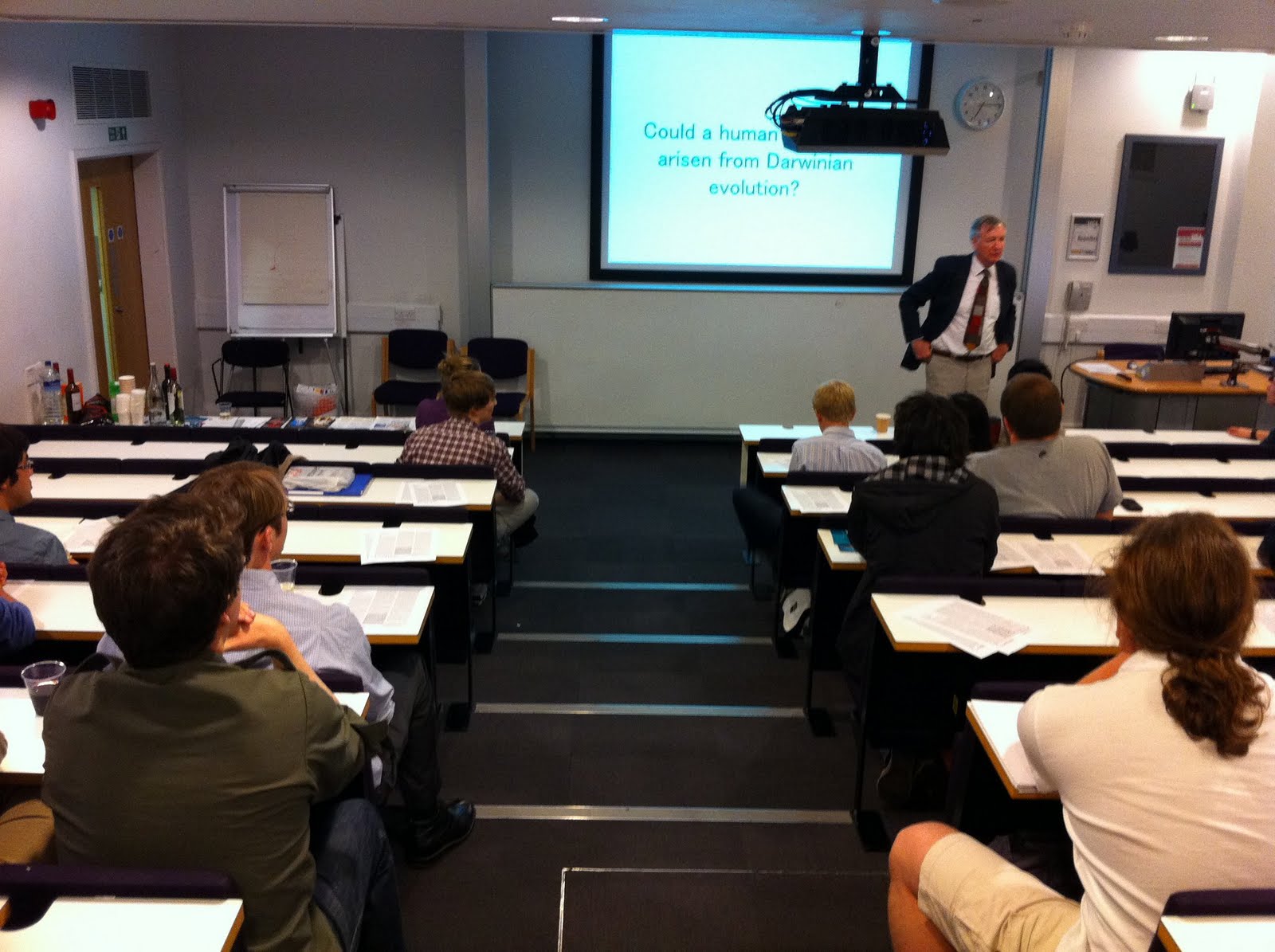
Event report: Prof. John Martin – ’Could a human soul have arisen from Darwinian evolution?’

Time: 3 May 2011, 19:00 - 20:30

Place: G08 Roberts Building, Malet Place, University College London


For our first event of the term, UCLU ASHS invited Professor John Martin, Chair of Cardiovascular Medicine at UCL and Professor Adjunct in Cardiology at Yale University, to hold a talk. With over 25 years of experience as a cardiovascular physician and academic researcher, some of his former roles include Vice President of the European Society of Cardiology and President of the European Society for Clinical Investigation. Additionally, he studied philosophy prior to qualifying from Sheffield University Medical School. He came to us to share his thoughts on human beings – and the human “soul”, in particular – as a qualitative, rather than quantitative, extension from evolution.


Prof. Martin first structured his talk around a number of questions establishing his philosophical view of understanding the universe:

1. Is man machine or not?

Prof. Martin rejected the conventional notion that neurobiology can account for all aspects of human beings as “a load of rubbish”: functional magnetic resonance imaging (fMRI) research does not provide any explanations as to what humans are, but merely anatomical observations.

2. Is experimental science the only truth?

Again, he stressed that science is only a series of measurements and observations, which can generate predictions, but not explanations. Whilst he “believed in Darwinian evolution absolutely”, he also expressed a strong belief in Freudian psychoanalysis as a means to discover the truth about yourself - likening knowledge of the origin of the self with knowledge of the origin of the world.

3. What is the cause of the Big Bang?

Here, he made the suggestion that this cause could be the things it produced, including immutable constants such as pi, Avogadro’s number and the speed of light – indeed, that the nature of god could be these constants. A question was raised from the audience of whether he could simply label this “thing” manifesting itself as physical constants as “God”, to which Prof. Martin referred back to psychoanalysis: “you are your psychoanalytic nature more than your neural connections,” hence, although you cannot use scientific methods to explain the nature of the universe, you can reach an understanding of it through a subjective truth – “it feels true to me.” Not surprisingly, this generated a small debate on what “truth” is.

4. Is religion daft?

Having been brought up a Roman Catholic, he emphasised its important part of European history, and the practicality of prayer as a cheap form of psychoanalysis to better understand oneself. He also stressed that acknowledging the usefulness of religion does not necessarily entail believing in the bearded man in the sky. The audience responded to this by pointing out that it is the practice of verbalising thought to clarify ideas rather than the spiritual element that makes prayer useful: religion in itself is daft – however, we can extract useful parts from it.

5. Is art superior to science?

“Absolutely so.” Superior to the purely observational function of science, Prof. Martin argued, is the ability of art to interpret the internal mechanisms of humans: art, unlike science, cannot exist independently of a creator.

6. Does metaphysics exist?

Although it cannot be tested with the scientific method, he argued it does indeed exist, as “an existing thing cannot exist and not exist at the same time.”


From this, he went on to the main topic of the talk: chimpanzees and humans have nearly identical DNA – although “identical” was disputed among the audience -, yet humans are different in that we have free will and abstract thought. Prof. Martin suggested this difference could not have arisen from a quantitative mechanism, but from a qualitative one, i.e. humans have an "abstractor" independent of our constituent biological building blocks. To illustrate this point further, he paralleled this with a symphony existing independently of its constituent notes, or even the difference between a bent and straightened finger existing independently of the finger itself. What we consider the human soul, then, could be a manifestation of this abstractor of consciousness and free will, which at some point in evolution evolved by leaping off the quantitative progression above a certain threshold.


Prof. Martin made several postulations that generated questions from the audience, e.g. how can we know that chimpanzees do not have abstract thought, or even that human consciousness is not just an artifact of biological reflexes? Is it not more parsimonious to argue abstract thought evolved from an expansion of the cerebral cortex, rather than a qualitative threshold event? When determinism was brought up, for instance, he replied he accepts the possibility of determinism, yet acts on the assumption that we have free will, as it enhances his life and gives it happiness and pleasure. In sum, Prof. Martin argued his conjecture was a philosophical one, hence one must look beyond the trivialities of science.


Further discussion of Prof. Martin's ideas (objections to them, by and large) followed at Jeremy Bentham's, before it dissolved into various topics - including the recent Royal Wedding. We hope all who attended enjoyed the talk and the break from revision for those who had exams!


Click here for an article Prof. Martin wrote on the topic covered in the talk.