Showing posts with label human soul. Show all posts

Tuesday, 6 March 2012

Event report: Prof Volker Sommer - 'Apes Like Us: Confessions of a Primatologist'

Time: 2 February 2012, 19:00 - 21:00
Place: Gavin de Beer LT, Anatomy Building, University College London

UCLU ASHS welcomed Volker Sommer, Professor of Evolutionary Anthropology at UCL, to give us a talk on our tendency to distinguish ourselves from animals, and what he believes is the true relationship between human beings and non-human primates. His research revolves around the behavioural ecology of apes in the wild, much of which is covered in his upcoming book, Apes Like Us. 


Prof Sommer began his talk outlining the deep-rooted folk view of defining a dichotomy between humans and animals. As we like to construct our knowledge of the world using heuristics, or rules of thumb, we like to perceive the world in dichotomous terms, i.e. black vs. white, human vs. animal, and enlightened vs. primitive. This is echoed in the Cartesian dual-mind hypothesis, namely that body and soul, or matter and mind, are separate entities. This separation of ourselves from animals started falling apart, however, with Darwinian theory and a paradigm shift towards the notion of human and other animals having a shared common history. Thus, 'longitudinally', Prof Sommer explained, 'dichotomy disappeared.'


What followed was the view of naturalism, which posited that not only are other animals mechanistic or machine-like governed by nothing but natural laws, but that humans are merely machines as well. Humans are the result of nature and evolution - like other things including plants and bacteria, 'we also consist of stuff'.

Hence, we should advocate the view of materialism and monism, rather than dualism. Nevertheless, there is a human tendency to want dualism: Prof Sommer refer to the German word Sonderstellung, i.e. 'special place', as a way to describe our desire to be unique and establish that there are qualitative differences between humans and other animals. With the sentiment of 'of course evolution took place, but humans are very, very special!', people increasingly substitute the lack of body-soul dualism by reinventing a divide between humans and animals. This concept of Essentialism, i.e. that humanity is essentially something different and special, Prof Sommer argued, is even shared by 'enlightened people who want to feel connected to the cabbages and the chimpanzees and the cockroaches and so on.' This is further reflected in Humanism, in which humans are perceived have individual value and inherent human rights, setting us apart from animals.

Prof Sommer then went on to advance his own view, Gradualism, which is the paradigm of contemporary evolutionary anthropology. The gradualist view is that we are all unique, both humans and other animals, yet there is a similarity in hardware between the two that you cannot discuss away with Essentialism. He argued for this view by providing several examples of studies with apes and monkeys, both in the wild and with domesticated animals. Chimpanzees in the wild intentionally make brush ends of sticks from trees in order to create a spoon-like tool to get honey out of nests of bees. They are also able to use tools in succession, e.g. using a large stick to try and find a spot where they can insert a smaller stick in tree trunks and on the ground to look for termites.

Prof Sommer also showed several videos of non-human primates displaying tool use, intent, and high cognitive abilities.


Prof Sommer's take home points were that, in nature, there is gradualism, and thus we should be against the notion of specism in the same manner we are against sexism and racism. He advocates an enlargement of the community of equals and that great apes should be entitled to legal rights under legal bodies, similarly to humans. 

Following a Q&A session covering topics such as social constructivism and whether non-human primates can exhibit suicidal tendencies, Prof Sommer joined us at the Bentham for further enlightening discussions.

Thursday, 26 May 2011

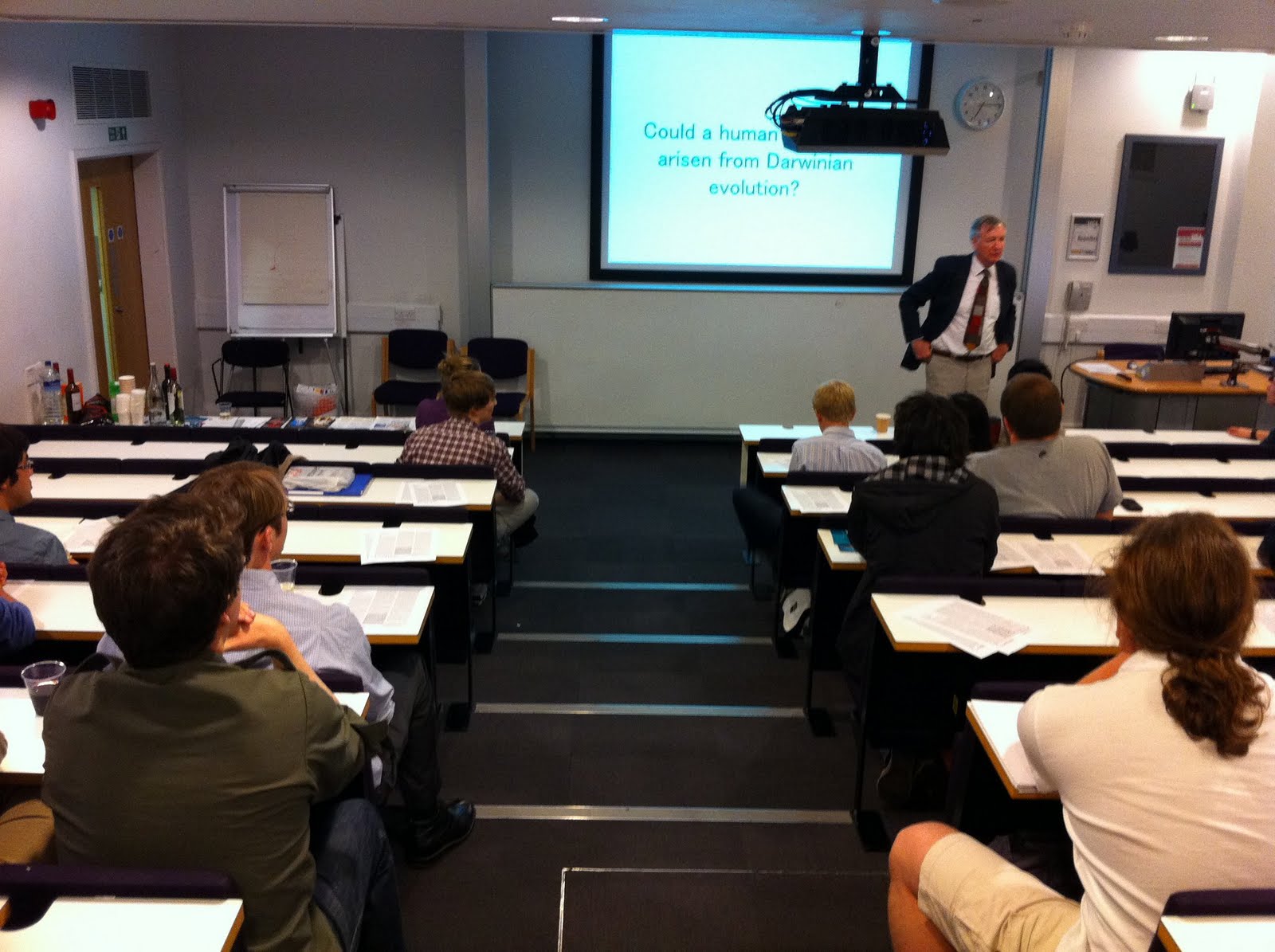
Event report: Prof. John Martin – ’Could a human soul have arisen from Darwinian evolution?’

Time: 3 May 2011, 19:00 - 20:30

Place: G08 Roberts Building, Malet Place, University College London


For our first event of the term, UCLU ASHS invited Professor John Martin, Chair of Cardiovascular Medicine at UCL and Professor Adjunct in Cardiology at Yale University, to hold a talk. With over 25 years of experience as a cardiovascular physician and academic researcher, some of his former roles include Vice President of the European Society of Cardiology and President of the European Society for Clinical Investigation. Additionally, he studied philosophy prior to qualifying from Sheffield University Medical School. He came to us to share his thoughts on human beings – and the human “soul”, in particular – as a qualitative, rather than quantitative, extension from evolution.


Prof. Martin first structured his talk around a number of questions establishing his philosophical view of understanding the universe:

1. Is man machine or not?

Prof. Martin rejected the conventional notion that neurobiology can account for all aspects of human beings as “a load of rubbish”: functional magnetic resonance imaging (fMRI) research does not provide any explanations as to what humans are, but merely anatomical observations.

2. Is experimental science the only truth?

Again, he stressed that science is only a series of measurements and observations, which can generate predictions, but not explanations. Whilst he “believed in Darwinian evolution absolutely”, he also expressed a strong belief in Freudian psychoanalysis as a means to discover the truth about yourself - likening knowledge of the origin of the self with knowledge of the origin of the world.

3. What is the cause of the Big Bang?

Here, he made the suggestion that this cause could be the things it produced, including immutable constants such as pi, Avogadro’s number and the speed of light – indeed, that the nature of god could be these constants. A question was raised from the audience of whether he could simply label this “thing” manifesting itself as physical constants as “God”, to which Prof. Martin referred back to psychoanalysis: “you are your psychoanalytic nature more than your neural connections,” hence, although you cannot use scientific methods to explain the nature of the universe, you can reach an understanding of it through a subjective truth – “it feels true to me.” Not surprisingly, this generated a small debate on what “truth” is.

4. Is religion daft?

Having been brought up a Roman Catholic, he emphasised its important part of European history, and the practicality of prayer as a cheap form of psychoanalysis to better understand oneself. He also stressed that acknowledging the usefulness of religion does not necessarily entail believing in the bearded man in the sky. The audience responded to this by pointing out that it is the practice of verbalising thought to clarify ideas rather than the spiritual element that makes prayer useful: religion in itself is daft – however, we can extract useful parts from it.

5. Is art superior to science?

“Absolutely so.” Superior to the purely observational function of science, Prof. Martin argued, is the ability of art to interpret the internal mechanisms of humans: art, unlike science, cannot exist independently of a creator.

6. Does metaphysics exist?

Although it cannot be tested with the scientific method, he argued it does indeed exist, as “an existing thing cannot exist and not exist at the same time.”


From this, he went on to the main topic of the talk: chimpanzees and humans have nearly identical DNA – although “identical” was disputed among the audience -, yet humans are different in that we have free will and abstract thought. Prof. Martin suggested this difference could not have arisen from a quantitative mechanism, but from a qualitative one, i.e. humans have an "abstractor" independent of our constituent biological building blocks. To illustrate this point further, he paralleled this with a symphony existing independently of its constituent notes, or even the difference between a bent and straightened finger existing independently of the finger itself. What we consider the human soul, then, could be a manifestation of this abstractor of consciousness and free will, which at some point in evolution evolved by leaping off the quantitative progression above a certain threshold.


Prof. Martin made several postulations that generated questions from the audience, e.g. how can we know that chimpanzees do not have abstract thought, or even that human consciousness is not just an artifact of biological reflexes? Is it not more parsimonious to argue abstract thought evolved from an expansion of the cerebral cortex, rather than a qualitative threshold event? When determinism was brought up, for instance, he replied he accepts the possibility of determinism, yet acts on the assumption that we have free will, as it enhances his life and gives it happiness and pleasure. In sum, Prof. Martin argued his conjecture was a philosophical one, hence one must look beyond the trivialities of science.


Further discussion of Prof. Martin's ideas (objections to them, by and large) followed at Jeremy Bentham's, before it dissolved into various topics - including the recent Royal Wedding. We hope all who attended enjoyed the talk and the break from revision for those who had exams!


Click here for an article Prof. Martin wrote on the topic covered in the talk.