Showing posts with label free will. Show all posts

Monday, 30 January 2012

Event report: Philip Satherley - 'The Case for Assisted Dying'

Time: 19 January 2012, 19:00-21:00
Place: Ramsay LT, Christopher Ingold Building, University College London

We invited Philip Satherley, the Research and Policy Officer of Dignity in Dying (DiD), to give a talk on assisted dying.


DiD is a UK organisation campaigning for the legislation of assisted dying for terminally ill, mentally competent adults. They work alongside Compassion in Dying, a partner organisation focused on informing and supporting terminally ill individuals concerning their current choices and rights at the end of life.

To introduce the topic, Satherley sought to clarify what is meant by assisted dying, and its definition relative to similar concepts:
  • Assisted dying applies to terminally ill, mentally competent adults who are medically deemed to have less than 6 months to live; and who have met strict criteria and safeguards, including psychological tests. This involves the patient receiving life-ending medication, which they will self-administer at their own will - quite often this is done at a very advanced stage in their terminal illness. Assisted dying is practiced legally in Oregon and Washington. 
  • Assisted suicide applies to not only terminally ill individuals, but also chronically ill and disabled individuals who wish to receive assistance to terminate their life. This is legalised in Switzerland. 
  • Voluntary euthanasia allows a medical doctor to administer life-terminating medication - usually injection - directly to the patient. Strict safeguards and tests are still undergone. Voluntary euthanasia is practiced in the Netherlands and Belgium. 
  • Non-voluntary euthanasia applies to cases where the patient has lost all mental capacity, yet a third-party administers life-ending medication without the explicit consent of the patient. This is not to be confused with involuntary euthanasia, which is when euthanasia is performed against the will of the patient. While illegal all across the world, non-voluntary euthanasia is practiced in the Netherlands under the Groningen Protocol.
Satherley stressed that DiD campaigns for assisted dying only, specifically addressing critical safeguards such as appropriate mental capacity, 18 years of age, the patient having a terminal illness and voluntarily and repeatedly having requested assisted dying.


Two examples of personal stories illustrate the types of cases DiD works with:
  • Waltraud Coles: Waltraud's husband wrote to DiD telling them about his wife's struggle with advanced secondary progressive multiple sclerosis. Due to excessive fatigue and severely limited mobility, severe side effects from partially effective pain relief, and an onset of pneumonia, she self-terminated her life by refusing all foods and water for 19 days. Her last words were: "Society is making me die in this abysmally cruel way. Society is anybody who cannot be bothered to lift one single finger to change this (current) inhumane law, and thus give completely helpless people like myself, in the very advanced phase of a degenerative illness, no other legal option (than starvation) when we want to end the unbearable daily ordeal which is all that is left of our 'life'."
  • Geraldine McClelland: A member of DiD, Geraldine contacted the organisation when she was informed of her terminal illness - lung and liver cancer metastasised from breast cancer. On the day of her death, she wrote a letter to DiD, detailing her actions and what she believed needed to be changed in UK legislation regarding assisted dying. Her condition, which involved serious breathing problems, had confined her to her home. She wanted the option to take life-ending medication to terminate her life surrounded by friends and family. However, as UK laws prevent this, she travelled to Dignitas, an assisted dying organisation in Switzerland. As she could not die in her own country, she pleaded for the UK laws to be changed such that other people would not need to travel abroad in order to die. 
Importantly, and also expressed by Waltraud Coles, Geraldine believed loved ones should not be in a position of breaking the law in such situations. Debbie Purdy, suffering from multiple sclerosis, won a significant case through the House of Lords where she succeeded in arguing that the partner of a terminally ill patient should not be prosecuted when accompanying them abroad for assisted dying.

Satherley proceeded to summarise why DiD strongly believes laws should be changed to allow assisted dying in the UK:
  • Personal autonomy: as Sir Patrick Stewart, one of the patrons of DiD, put it - "We have no control over how we arrive in the world, but at the end of a life we should have legal control over how we leave it."
  • Research from Oregon: approximately 40% of patients receiving life-terminating medication choose not to use it, but consider the option a great comfort or an 'insurance policy'; most patients are well-educated, medically insured (i.e. no financial difficulty), had no prior disabilities or mental illness, and had cancer as the underlying cause of illness; and while some had symptoms of depression, all patients receiving assisted death had full mental capacity and were able to make rational decisions. 
  • Opinions of the general public: the 2010 British Attitude Survey (BAS) found that 82% of the general public supported assisted suicide, and the 2008 BAS found that 80% supported assisted dying. 
  • Opinions of religious people: breaking down the survey between religious and non-religious people, the 2010 BAS found that 92% of non-religious people supported assisted dying and assisted suicide, while 72% of religious people did the same.

One important question that was raised during the following Q&A session was why DiD campaigns for assisted dying, specifically, and not the other forms of euthanasia. Satherley stressed the importance of having safeguards in place, e.g. ensuring that the patient has a terminal illness, and not a chronic illness or disability which may be open for improvement of life quality. Moreover, DiD believes it is essential that physicians are involved as there are problems with taking the procedures out of the medical system; and that voluntary euthanasia ultimately takes the final decision out of the hands of the patient by - to an extent - forcing the practitioner to end an individual's life. 

DiD campagins for what the UCLU ASHS believes is a very important cause, and they are always looking for people to get involved. If you want to join the campaign, they can be found on Facebook and Twitter.

Friday, 25 November 2011

Event report: Interfaith panel discussion - 'Should Britain be a Secular State?'

Time: 17 November 2011, 18:30 - 21:00
Place: Ricardo LT, Drayton House, University College London


For our first panel discussion, UCLU ASHS invited the university's faith societies to explore the topic of secularism. The panel consisted of representatives from UCLU AMSA (Tahir Nasser) and UCLU Catholic Society (Kajtek Skowronski), as well Treasurer Kieran on our behalf, while President Robbie chaired the discussion.

Each of the panelists were first given 3 minutes to express their views on secularism in the UK. AMSA, highlighting citations from the Koran, advocated a view of 'You for your religion and me for my religion': the ruling religion in a non-secular state would impose restrictions on the minority religions. This would conflict with the Islamic principle of justice, as 'secularism is justice.' Hence, the role of religion in society should be to guide, but not dictate, legislature. Echoing this sentiment, CatholicSoc expressed that theocracy will not work in society - highlighting that Jesus believed the church and state were distinct -, but that religion should still maintain an active role of positive moral guidance in a system grounded by secular reason. A note was also made on how UCL's secular roots was the first university in England to admit Catholic students. Finally, ASHS brought up the issue that although the UK policy is to treat all religions as equal, this does not necessarily prevent the conflicts we would wish for secularism to prevent. Moreover, the Judeo-Christian foundations of the UK still has its influences in this society, as evidenced by e.g. the Queen being Head of State and Bishops in the House of Lords.

As each of the three societies represented were in favour of a secular Britain, then, the Q&A session of the discussion revolved around the more fine-grained differences in their approaches to a secular state. A question from the audience led to reflections from each of the panelists on their stance on government-funded faith schools in the UK. AMSA conceded that allowing for private faith schools will uphold the principle of free will, whereas public schools should teach morality common to all religions, rather than promote any one religion over others. Conflicts within religions are too many and too complex to avoid implicitly favouring one religious view. Contrastingly, CatholicSoc argued in favour of public faith schools by pointing out that the free choice of schools is still maintained, and that government funding is not significantly drained by maintaining faith schools. Moreover, it was stressed that faith schools do not necessarily limit diversity in the student population, as many Catholic schools are attended by a wide variety of non-Catholic ethnic minorities. Countering this, Kieran representing the ASHS reflected on his own experience in Catholic schools, noting that despite being in one of the most multicultural areas in the UK, the vast majority of his peers were Catholic. Nevertheless, faith schools should be upheld, he argued, as this would allow for 'atheist academies', i.e. 'you have to play along to get along.'

The topic of faith schools was further explored in detail between the panelists and the audience members: to what extent is admitting a child to a faith school an act of labelling or priming an individual without self-awareness? Here, CatholicSoc pointed out that regardless of admission to faith school, children cannot be brought up with blank slates, and that as long as faith schools teach the national curriculum, religious supplementary input is not a negative influence if this is what the parents wish for their child. Another issue raised by the audience, was that while public funding of faith schools may not necessarily be financially detrimental, it is also a question of morals, as individuals would not want their tax money to contribute towards values they do not support.

Following continued discussion of other less strictly relevant (but inevitable) issues including human versus religious morality and whether there is such a distinction, as well as abortion and ethics, each of the panelists summarised their views. CatholicSoc asserted that a secular state should not undermine the role of religion, but value well-reasoned religious beliefs; ASHS cast reflection on how religion will still inevitably influence a secular state, in particular discussions regarding abortion and LGBT - an influence which must be accepted for democratic reasons; while AMSA expressed surprise at the knowledge of Britain's non-secular influences during the discussion, and stressed that although a secular state free of any ruling religion would be the only just form of government, non-secular influences such as the monarchy should not be removed as this would demonstrate injustice to the country's heritage.

Thursday, 26 May 2011

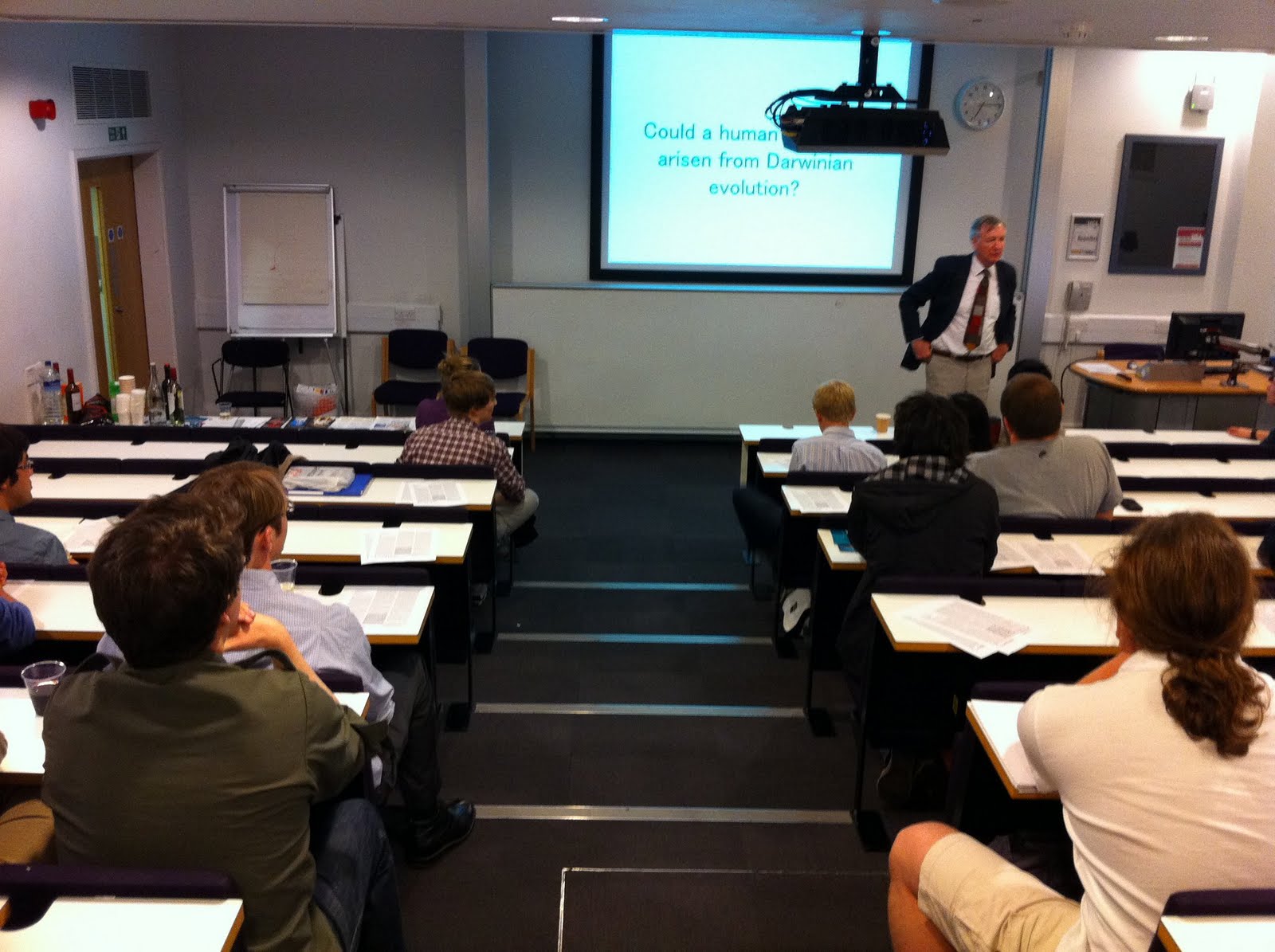
Event report: Prof. John Martin – ’Could a human soul have arisen from Darwinian evolution?’

Time: 3 May 2011, 19:00 - 20:30

Place: G08 Roberts Building, Malet Place, University College London


For our first event of the term, UCLU ASHS invited Professor John Martin, Chair of Cardiovascular Medicine at UCL and Professor Adjunct in Cardiology at Yale University, to hold a talk. With over 25 years of experience as a cardiovascular physician and academic researcher, some of his former roles include Vice President of the European Society of Cardiology and President of the European Society for Clinical Investigation. Additionally, he studied philosophy prior to qualifying from Sheffield University Medical School. He came to us to share his thoughts on human beings – and the human “soul”, in particular – as a qualitative, rather than quantitative, extension from evolution.


Prof. Martin first structured his talk around a number of questions establishing his philosophical view of understanding the universe:

1. Is man machine or not?

Prof. Martin rejected the conventional notion that neurobiology can account for all aspects of human beings as “a load of rubbish”: functional magnetic resonance imaging (fMRI) research does not provide any explanations as to what humans are, but merely anatomical observations.

2. Is experimental science the only truth?

Again, he stressed that science is only a series of measurements and observations, which can generate predictions, but not explanations. Whilst he “believed in Darwinian evolution absolutely”, he also expressed a strong belief in Freudian psychoanalysis as a means to discover the truth about yourself - likening knowledge of the origin of the self with knowledge of the origin of the world.

3. What is the cause of the Big Bang?

Here, he made the suggestion that this cause could be the things it produced, including immutable constants such as pi, Avogadro’s number and the speed of light – indeed, that the nature of god could be these constants. A question was raised from the audience of whether he could simply label this “thing” manifesting itself as physical constants as “God”, to which Prof. Martin referred back to psychoanalysis: “you are your psychoanalytic nature more than your neural connections,” hence, although you cannot use scientific methods to explain the nature of the universe, you can reach an understanding of it through a subjective truth – “it feels true to me.” Not surprisingly, this generated a small debate on what “truth” is.

4. Is religion daft?

Having been brought up a Roman Catholic, he emphasised its important part of European history, and the practicality of prayer as a cheap form of psychoanalysis to better understand oneself. He also stressed that acknowledging the usefulness of religion does not necessarily entail believing in the bearded man in the sky. The audience responded to this by pointing out that it is the practice of verbalising thought to clarify ideas rather than the spiritual element that makes prayer useful: religion in itself is daft – however, we can extract useful parts from it.

5. Is art superior to science?

“Absolutely so.” Superior to the purely observational function of science, Prof. Martin argued, is the ability of art to interpret the internal mechanisms of humans: art, unlike science, cannot exist independently of a creator.

6. Does metaphysics exist?

Although it cannot be tested with the scientific method, he argued it does indeed exist, as “an existing thing cannot exist and not exist at the same time.”


From this, he went on to the main topic of the talk: chimpanzees and humans have nearly identical DNA – although “identical” was disputed among the audience -, yet humans are different in that we have free will and abstract thought. Prof. Martin suggested this difference could not have arisen from a quantitative mechanism, but from a qualitative one, i.e. humans have an "abstractor" independent of our constituent biological building blocks. To illustrate this point further, he paralleled this with a symphony existing independently of its constituent notes, or even the difference between a bent and straightened finger existing independently of the finger itself. What we consider the human soul, then, could be a manifestation of this abstractor of consciousness and free will, which at some point in evolution evolved by leaping off the quantitative progression above a certain threshold.


Prof. Martin made several postulations that generated questions from the audience, e.g. how can we know that chimpanzees do not have abstract thought, or even that human consciousness is not just an artifact of biological reflexes? Is it not more parsimonious to argue abstract thought evolved from an expansion of the cerebral cortex, rather than a qualitative threshold event? When determinism was brought up, for instance, he replied he accepts the possibility of determinism, yet acts on the assumption that we have free will, as it enhances his life and gives it happiness and pleasure. In sum, Prof. Martin argued his conjecture was a philosophical one, hence one must look beyond the trivialities of science.


Further discussion of Prof. Martin's ideas (objections to them, by and large) followed at Jeremy Bentham's, before it dissolved into various topics - including the recent Royal Wedding. We hope all who attended enjoyed the talk and the break from revision for those who had exams!


Click here for an article Prof. Martin wrote on the topic covered in the talk.