Sunday, 30 October 2011

Reasonable Faith? - A Review from ULU

Recently, as part of his much publicized “Reasonable Faith Tour”, William Lane Craig graced the University of London Union. His talk, entitled “Can we be good without God?”, was brought to us, so his banners gleefully informed, by BeThinking.org and the University and Colleges Christian Fellowship (U.C.C.F). Professor Craig has certainly received a high praise over the past year, with Sam Harris describing him as “the one Christian apologist who seems to have put the fear of God into many of my fellow atheists”, and has been described by various people as the foremost christian apologist in the world.

From the offset, Professor Craig was careful to state exactly what he meant to establish over the course of the talk. It was not, he was quick to state, about whether those without religion could lead moral lives, which he made certain to emphasise they could. It was about whether the entire idea of “good” has any basis without a God. He stated that there are three answers to the question of morality; Theism, which grounds morality in God; Humanism, which grounds good in humanity; and Nihilism, which claims that there is no grounding for morality, and that morality is illusory.

From here, he turned to the question of whether morality is objective, or subjective. If God exists, he claimed, there is an objective morality, decided by God. If He does not exist, there is only a subjective “moral fashion”. Addressing the Euthyphro Dilemma (that is, the question of “Is what is morally good commanded by God because it is morally good, or is it morally good because it is commanded by God?”), the Professor asserts that the dilemma is a false dichotomy, and that God is the very definition for good. God, he claimed, underwrites moral responsibility, because it is His expression of His character and goodness. The choices of mankind, he observed, are acted out in a manner that appears to be infused with objective morality. He ignored the fact that this appearance does not mean that it is the case that the choices of mankind in fact are infused with objective morality.

He proceeded to address the idea of morality as a product of evolution. This, he said, would make morality simply a survival aid, and nothing more. He elaborated that “If men were reared as hive bees, our females would find it moral to kill their brothers, and mothers their daughters”. This, he then said, would create “objective worthlessness”, without really providing a justification for such claims. In a sudden leap, we were looking at dualism, which, Craig claimed, if untrue would mean that determinism would reign and morality as a concept would break down. He doesn't give any argument for dualism other than that it is preferable to not find ourselves in a deterministic universe. This plea to the more philosophically pleasing option would become an undertone in his arguments from this point in. If morality were subjective, rapists would simply be akin to a moral “Lady Gaga...out of step with 'moral fashion'”, claimed the Professor, and then again return to reinforce the idea that atheists may live moral lives, but only if God exists, as God defines what is moral.

Now came an incredible claim on behalf of the Professor. Subjective ethics, he claimed, led us previously, and could lead us again, to the Holocaust. If naturalism is correct, the world is effectively equitable to Aushwitz, and there could be no moral objections to such actions, if there was no God to underwrite the objections. “If there is no immortality, everything is permitted” he asserted, without giving an justification for such a claim. Morality would purely exist out of self interest.

In conclusion, Professor Craig boiled down his argument as follows; if there is a God, objective morality exists; if there is no God, we are left to nihilism. He felt he had dispelled humanism sufficiently, it seems, to have wiped it from his final consideration. A disappointing performance for a man who it is said is the foremost Christian apologist in the world, and certainly not up to the high praise of Sam Harris.

Jacob Tierney
University College London

Sunday, 16 October 2011

Event report: Paul Sims - "Criticising Islam: Free Speech or Bigotry?"

Time: 13 October 2011, 19:00 - 21:00
Place: Darwin Biochemistry LT, Darwin Building, University College London

Following the successes of past events with Paul Sims, including a talk on the importance of keeping a dialogue with believers, UCLU ASHS was happy to welcome the News Editor of New Humanist Magazine back to chair a debate on the grey area between criticism of Islam and Islamophobia.

Sims introduced the topic with a reference to Conservative minister Baroness Warsi's comment earlier this year on how open criticism of Islam is now so widespread, it has "passed the dinner-table test." This provoked strong reactions from secularists, who assumed the Baroness was criticising the critique of Islam. While he initially agreed with her critics, Sims now find himself seeing eye to eye with Baroness Warsi, citing two important concerns: i) the rise of the EDL (English Defence League) and in particular their intimidating and violent protests against not only Islamist groups, but Muslims in general; and ii) the way in which media, in particular right-wing tabloids, demonise Muslims and portray them as a threat to the country (examples here and here). Is it evident, then, that the Baroness is correct in that constructive criticism has crossed the line to biased bigotry?

We were delighted to see that there were amongst the audience, not only atheists and the non-religious, but also religious debaters discussing the matter from their viewpoints, including those of the Christian faith and members of UCLU AMSA. The debate that followed Sims' introduction explored various issues, some of which are summarised below.

  • Where do humanists and secularists stand in relation to Islamophobia? Our friends from AMSA highlighted the importance of not polarising Muslims and humanists/secularists. They explained that while they do not agree with atheism, they consider themselves both humanists and secularists, as they define humanism as the promotion of human welfare, and view secularism a strong root of Islam. Input from the humanist point of view put forth the question of whether Islamophobia is directed towards the religion or towards the religious, and that this is important in distinguishing between religious critique and prejudice. 
  • What is the difference between Muslim satire and Christian satire? The cover of the last edition of New Humanist depicts Ricky Gervais posing as Jesus Christ, which was put in contrast with the much-publicised Muhammad charicatures in the Danish newspapers in 2005. A debater argued that although he was personally offended by the magazine cover on the grounds of his Christian faith, he accepted that he is living in a secular and democratic society. He then proceeded to question why Muslims are given privilege when it comes to sensitivity to satire. A response to this from a non-religious debater was that attention should be directed towards whether or not the satire has any real political message, or whether it is meant to only offend - arguing that, unlike Gervais' cover, the Muhammad cartoons only intended the latter. A point raised from AMSA was that religious criticism must be interpreted in the context of the current political climate. For example, the first South Park episode portraying the Prophet Muhammad, albeit after the 11 September attacks, was broadcast prior to the Danish caricatures, and thus received comparatively little response.  
  •  Presenting religious criticism in the public sphere versus the non-public sphere: Most debaters seemed to agree that while they all were offended by statements and depictions disparaging their identities, beliefs, lifestyle choices and similar, they would not ban people's right to voice any opinions they might have - but that critics should be encouraged to exercise self-censorship. Sims contrasted this view of the freedom to say and publish anything you like in e.g. newspapers and magazines, i.e. in the public sphere where the public can choose for themselves whether they want to listen/read to it or not, with imposing your views directly on people in their personal space. Here, he made a reference to an incident where a militant atheist posted derogatory anti-religious images in an airport prayer room. In a sense, Sims argued, the atheist's freedom of speech limited the freedom of the users of the prayer room, as they due to personal convictions could no longer use the room.
The general opinion amongst the debaters, religious and non-religious alike, was that legislating any form of criticism would not solve any problems, but only make matters worse - especially in a society where freedom of speech is already so entrenched. Rather, any issue should be approached in an intellectual and respectful manner: when used, political/religious satire should have a real message; and negative reactions to such satire should encourage dialogue instead of polarisation.

Following the debate, we made the usual trip to the Bentham where Sims also joined us to continue the discussion. Thanks to everyone who attended - we hope to see more input from our religious co-students (and non-students) in future events!

"Argument for a Secular Britain" - Haris Ismail

The ideal of true secularism holds firm the view that the church and state must be kept entirely separate. In a society adhering to this basic principle, each person is to be treated as an individual where equality in the political, legal and educational systems regardless of religious belief is of paramount importance. In the words of Thomas Jefferson, one of America’s founding fathers, a secular society is one in which “no man shall be compelled to frequent or support any religious worship, place, or ministry whatsoever” and furthermore the religious shall not be afforded any privileges or special treatment simply because of their beliefs. Why is it then, that in today’s supposedly secular society, religious leaders are still treated with sycophantic reverence and given the platform and the power to influence the way our country is run?

Perhaps the most shocking example of this religious special treatment is found in the second chamber of the British parliamentary system: the House of Lords. Currently sitting in the Upper House in Westminster are 26 unelected Protestant Bishops; men (note, not women) who have the power to amend or reject crucial bills that could potentially play a decisive role in determining the laws of the land. Known as the “Lords Spiritual”, these Bishops are an unwanted remnant of the 1661 Clergy Act – unwanted not only by me, but by 74% of the population who agree that “it is wrong that Church of England bishops are given an automatic seat in the House of Lords”. The most common defence of their presence is that their position as religious leaders somehow affords them a greater and more authoritative insight into matters ‘spiritual’ or ‘moral’. This view is not only patronising and offensive, it is simply incorrect. Put it this way: in a debate on assisted suicide would you rather the people with the power to shape the law based their conclusions on reason and evidence, as medical ethicists and moral philosophers do, or on out-dated and irrelevant scripture and the even more reprehensible justification of ‘faith’? Indeed, this very issue highlights another strong argument against these unelected bishops in the House of Lords – they don’t always even represent the views of the majority within the institution they are supposed to represent, the Anglican Church. A 2004 vote on the Assisted Dying for the Terminally Ill Bill revealed that 81% of Protestants agree that “a person who is suffering unbearably from a terminal illness should be allowed by law to receive medical help to die, if that is what they want” and yet the bishops still opposed the bill.

The news of reform to the House of Lords may sound welcome to secularists across the country but Nick Clegg’s proposals, made in June this year, would actually see a 1% proportional increase of the number of bishops allowed to sit in parliament as of right. Furthermore, the Church is to be handed new powers to choose over half of their representatives – a fact that enables the religious authorities to work together with more cohesion to influence legislation. The British Humanist Association notes that “these proposals in effect create a new largely independent, and largely unaccountable, bloc for the Church of England in Parliament”.

Whilst bishops get a free ride in the House of Lords, there is another heinous privilege that our government and media afford the religious: freedom from scrutiny. A debilitating paranoia of causing offense serves to protect and preserve the role that religion plays in society, as we are constantly told to “respect” the beliefs of others.

The effects of this paranoia can be seen all around us. One of the biggest perpetrators of providing religion with undue protection from criticism is the BBC. Last year the state-funded broadcaster introduced new guidelines that were condemned by the National Secular Society as “a threat to free speech” and were seen to be “an entirely retrograde step [since] almost anything that isn’t wholly reverential towards religious beliefs can be perceived as offensive by some believers”. Special status is already given to religion on flagship programmes like Radio 4’s Thought for the Day (which invariably invites a religious figure to deliver an early-morning dose of meaningless spirituality) and significant portions of prime time news programmes are often devoted to informing the public that prayers are being held or religious vigils are being kept; information that is as meaningless as the act is useful. What’s more, under the new guidelines comedians, satirists and commentators wanting to be critical of religion have had their work strictly censored – a luxury that would never be afforded to other matters of individual choice like political affiliation or fashion sense and there is no reason why religious beliefs should be free from similar questioning.

A secular society does not have to be one that shuns religion completely; in as diverse and multicultural country as ours the freedom to practice one’s religion in peace is seen, quite rightly, as a fundamental right. However, a truly secular democracy ensures that such religious beliefs are kept out of government policy and legislation. To create such a society we must do as columnist Johann Hari proclaims, and ensure that “nobody is granted special rights just because they claim their beliefs come from an invisible supernatural being”.

Haris Ismail
University College London

Tuesday, 11 October 2011

Event report: Andrew Copson - ‘Objections To Humanism’

Time: Thursday 6th October 19:00-21:00
Place: Darwin Biochemistry lecture theatre, Malet Place, University College London


For the first event of the academic year the society hosted a talk by Andrew Copson, Chief Executive of the British Humanist Association (BHA) titled ‘Objections to Humanism.’ Andrew became Chief Executive of the British Humanist Association in January 2010 after five years coordinating the BHA's education and public affairs work. His writing on humanist and secularist issues has appeared in The Guardian, The Independent, The Times and New Statesman as well as in various journals and he has represented the BHA and Humanism extensively on television news on BBC, ITV, Channel 4 and Sky, as well as on television programmes such as Newsnight, The Daily Politics and The Big Questions. He is a former director of the European Humanist Federation (EHF) and is currently a Vice President of the International Humanist and Ethical Union (IHEU).

Andrew began by pointing out that being aware of the objections raised about humanism enables those who are humanist to be better armed to counter those criticisms raised, he also continued by saying that it is an obligation to be self-critical of one’s own world view including a humanist world view. Andrew went on to structure the talk on the basis of each criticism and how these should be addressed individually, the first being:

1. It diminishes the dignity of humanity.
Andrew points out here that essentially people are arguing that if we accept the evidence that people are nothing more than animals then how are we to act in any other way. His response consisted of the fact that just because we do not like the fact that we are animals it does not change it, being animals does not make us bestial.

2. Humanists can have no morals.
Here he gave an anecdote of a train journey back from a conference detailing his conversation with a priest, in which the priest could not believe how without religious dictate someone ‘wasn’t a rapist.’ Despite the raucous laughter in the room this and similar questions are often faced by many non- religious people. Clearly in response Andrew points out how this is a very bleak and false view of humanity, morals are not given by god, morality is an evolved system we use to coexist peacefully and sociably.

3. Too dry, too rational.
An example he uses is that often people argue that science cannot explain love. He counters this point by suggesting that science is the way to understand much because it is rational, universal and enquiry based, and that science can also be an inspiration.

4. It isn’t the way to explain everything.
In this rebuttal he states that explanations enhance but do not diminish, and that science’s remit is not to answer all the questions but to understand that which we can know.

5. A secular religion or “your pope Richard Dawkins.”
In response to this he describes the major tenets and concepts behind humanism as a movement, in doing so he explains how humanism is a collection of ideals and beliefs that have always existed in society. You cannot be a Christian without ever hearing of Christ, but you can be a humanist without ever hearing of humanism; as humanism describes an implicit belief system that already exists, the beliefs and values are as old as human history and are a permanent alternative.

6. A myth of human progress.
It is pointed out here that humanists are criticised for being too optimistic with an unwarranted sense of utopianism. Andrew talks about how we should be looking cautiously on the bright side, citing the BHA bus campaigns as an example. He also suggests that if you don’t believe in external help then you have to believe that normal men and women will do something, which makes progress more likely.

7. The pointlessness of it all or Nihilism.
To this idea Andrew calls the idea of the universe being meaningless a vain and ludicrous position. He also accepts here that from this perspective people often bring up a fear of death, but he suggests that death is something we should accept and live our life in accordance with reality.

8. What do you mean “that is all there is?”
He begins addressing this point by stating, what do you mean ‘all’? He adds that in making such statements you run the risk of undervaluing all that is here and now, in life the meaning comes in living, emphasizing the one life we have to live principle of humanism.

From Andrew concluding on the merits of the principle of having one life to live, the talk moved to a Q and A with members of the audience. Questions ranged from asking whether he altered his talk depending upon the audience being hostile or a ‘preaching to the choir situation’, Gaia theory, whether truth should be valued above all else, how best to enlighten your religious grandma (A C Grayling being suggested by Andrew) and how one could have hope knowing that people know right from wrong but do not always implement it. Andrew graciously continued the debate in the Jeremy Bentham pub afterward where as usual the conversation extended to various related and non-related topics. We would like to thank both Andrew Copson and everyone who attended the talk in making our first event of the new academic year a huge success.

If you would like to know more about humanism or become a member of the BHA there is a wealth of information at the BHA website: http://www.humanism.org.uk/home

Saturday, 1 October 2011

Freshers' Week 2011

A very warm welcome to all students new to UCL and the society, and welcome back to all familiar faces for an exciting new academic year! We have reached the end of the first week of the term, and what a great week it has been.

For Tuesday night, President Robbie booked the first floor of the Bentham for the society's welcome drinks social. If you missed out on this, do not despair - socials will be held at the Bentham every Tuesday during term time at 7.30pm. These are a great way to get to know the society members; discuss all matters related to atheism, secularism and humanism (and a number of other less relevant but equally engaging topics); or just enjoy a good drink and friendly conversation.


A prerequisite for the society to keep using the upper floor of the Bentham is that enough people attend these socials. If the turnout continues to be even just half of what it was on Tuesday night (30-35 people, if I am not mistaken), this is unlikely to be a problem. Packed with new and old students, AHS representatives, and UCL alumni, the room was bustling with good talk, good atmosphere and good minds - just like the Bentham should be.


This year's Freshers' Week was a milestone for the society: as UCLU ASHS did not become affiliated with the UCLU until January 2011, this is the first year we are having a stall among the over 200 official clubs and societies at the Freshers' Fayre.


Thursday and Friday saw a massive influx of freshers, non-freshers and other curious people in the UCL Main Quad and Wilkins Building. London suddenly deciding to introduce a heat wave (which was well-noticed inside the densely packed Fayre tents, to say the least) did not prevent an overwhelming response to The Godless of Gower Street: hundreds of people visited our stall for a flyer, affiliate materials, a chat about our society happenings, and an approving giggle at Dom's amazing cheezburger sign made for the Secular Europe rally - far outweighing the sporadic scowl sent in our direction. Moreover, we collected roughly 350 email addresses for our mailing list! An email will be sent out shortly to inform you of what we have in store for the coming months. Bear in mind, however, that instead of a weekly newsletter, the main society hub with all updates, activities and events is our Facebook group, whilst more detailed summaries of our events are posted in this blog.


We are now entering the Freshers' Try Fortnight, during which students can try out the different clubs and societies before deciding to officially join them. Our first Fortnight event is a talk held by BHA Chief Executive Andrew Copson entitled 'Objections to Humanism.' A highly talented and entertaining speaker, his is an event well worth attending - not least for the discussion that will follow the talk. For the second week, we are having New Humanist editor Paul Sims host a formal debate entitled 'Criticising Islam: Free Speech or Bigotry?' which will be a great opportunity for you all to get your debate. After Try Fortnight, you will have the option to join the society against a £3 membership fee for the coming academic year. This will entitle you to free entry to all our formal events, such as guest speaker events and panel discussions. Our weekly pub socials, however, will still be open for all, so do come along. Enjoy the remaining Freshers' Week and see you on Tuesday!

Tuesday, 31 May 2011

Event report: 'Is agnosticism a logical stance?' - a sit down debate

Time: 17 May, 19:00 - 21:00
Place: G17 Pearson Building, University College London

The usual informal discussions in the pub during our society meetings (and the many amusing directions they can take, ref. Kieran's panda analogy of the Queen) define the essence and drive of this society, namely intellectual curiosity and exchange of ideas. For our second event, we decided to keep a slightly less informal debate out of the pub, centered around a single topic: agnosticism - more specifically, is agnosticism the only logically valid approach to viewing the world?

The impossibility of certainty was compared with the need to establish a pragmatic degree of certainty in order to lead a productive life - "Should scientists abandon their jobs by acknowledging everything they don't know?" The existence of god cannot be disproved, hence from a purely logical point of view, there is no right way to live your life other than agnosticism. However, it was pointed out that there is a difference between actively following agnosticism - considered non-progressive - and merely having it in the back of your head. As with all scientific reasoning, where in this case the non-existence of a god is the null hypothesis and the existence of a god is the alternative hypothesis, definite support for the null hypothesis cannot be established. Instead, a certain confidence level to reach conclusions is set, from which you choose a direction to act on and live your life by.

The extent to which something supports a particular hypothesis was further discussed. On one hand, it was argued the concept of proof can only be found in mathematics and logic. In remaining domains, presumption is a matter of how appropriate the justification for something is. This was questioned with the argument that overwhelmingly strong evidence for something, e.g. fossils, is the closest one can get to truth, hence should be considered proof. However, evidence such as fossils is only proof in a pragmatic sense, it was countered, and conclusions are always open to interpretation.

The difference between having a passive stance and an explicit stance with regards to religion was also considered. People who declare themselves to be "not religious" were observed to often dissociate themselves from the "atheist" label, i.e. not knowing is not the same as believing it is impossible to know, and not believing in god is not the same as believing there is no god. Also, it was mentioned that atheists in the U.S. seemed to be more likely to explicitly declare their view on religion compared to less religious societies.

In conclusion, there was a general agreement that agnosticim might be the only logical stance, but not necessarily the most pragmatic stance. Emphasis was put on the importance of clarifying, when discussing religion - particularly with religious people -, that the vast majority of atheists do not claim there is definite proof against the existence of god.

Thursday, 26 May 2011

Event report: Prof. John Martin – ’Could a human soul have arisen from Darwinian evolution?’

Time: 3 May 2011, 19:00 - 20:30

Place: G08 Roberts Building, Malet Place, University College London
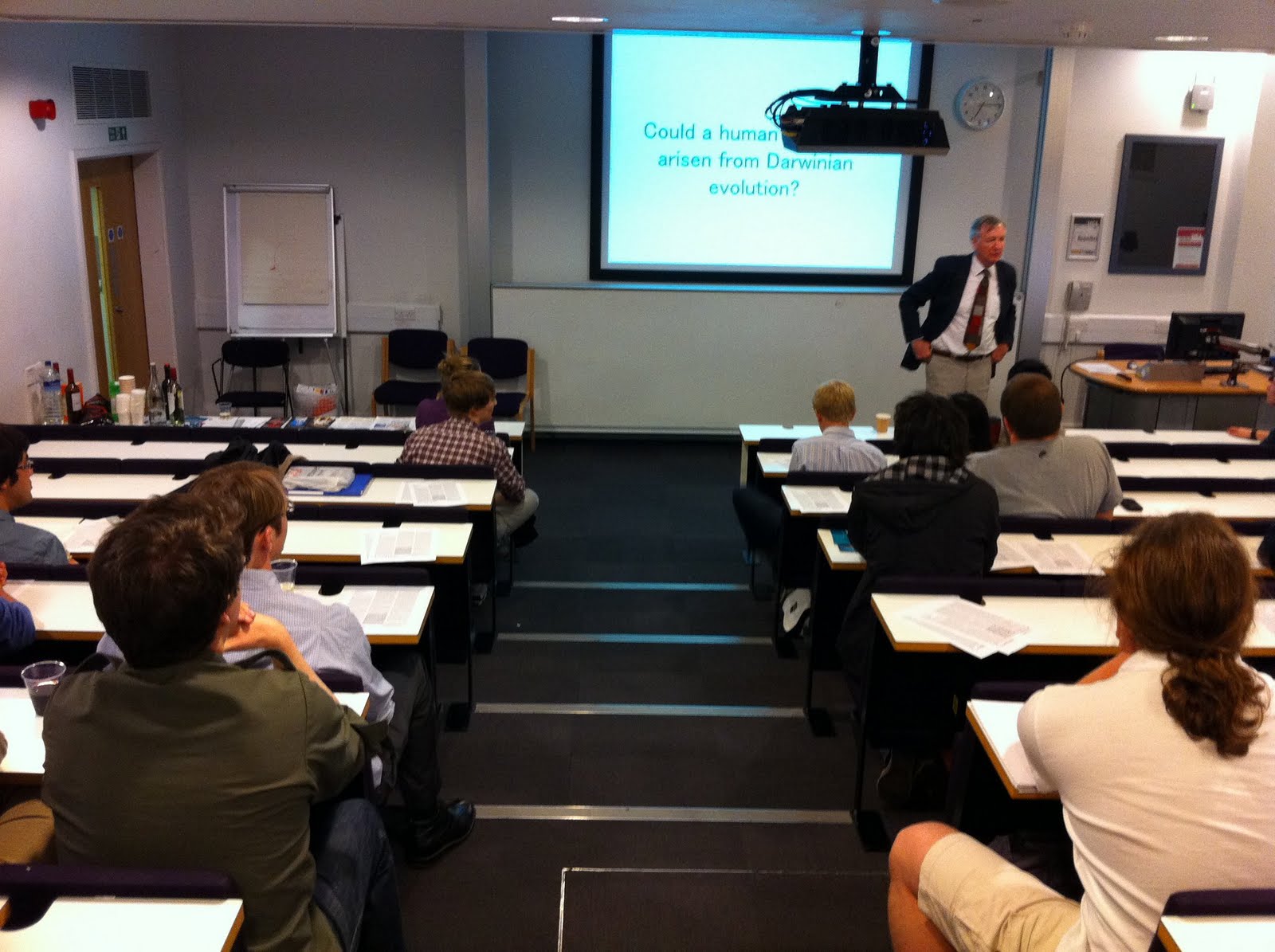

For our first event of the term, UCLU ASHS invited Professor John Martin, Chair of Cardiovascular Medicine at UCL and Professor Adjunct in Cardiology at Yale University, to hold a talk. With over 25 years of experience as a cardiovascular physician and academic researcher, some of his former roles include Vice President of the European Society of Cardiology and President of the European Society for Clinical Investigation. Additionally, he studied philosophy prior to qualifying from Sheffield University Medical School. He came to us to share his thoughts on human beings – and the human “soul”, in particular – as a qualitative, rather than quantitative, extension from evolution.


Prof. Martin first structured his talk around a number of questions establishing his philosophical view of understanding the universe:

1. Is man machine or not?

Prof. Martin rejected the conventional notion that neurobiology can account for all aspects of human beings as “a load of rubbish”: functional magnetic resonance imaging (fMRI) research does not provide any explanations as to what humans are, but merely anatomical observations.

2. Is experimental science the only truth?

Again, he stressed that science is only a series of measurements and observations, which can generate predictions, but not explanations. Whilst he “believed in Darwinian evolution absolutely”, he also expressed a strong belief in Freudian psychoanalysis as a means to discover the truth about yourself - likening knowledge of the origin of the self with knowledge of the origin of the world.

3. What is the cause of the Big Bang?

Here, he made the suggestion that this cause could be the things it produced, including immutable constants such as pi, Avogadro’s number and the speed of light – indeed, that the nature of god could be these constants. A question was raised from the audience of whether he could simply label this “thing” manifesting itself as physical constants as “God”, to which Prof. Martin referred back to psychoanalysis: “you are your psychoanalytic nature more than your neural connections,” hence, although you cannot use scientific methods to explain the nature of the universe, you can reach an understanding of it through a subjective truth – “it feels true to me.” Not surprisingly, this generated a small debate on what “truth” is.

4. Is religion daft?

Having been brought up a Roman Catholic, he emphasised its important part of European history, and the practicality of prayer as a cheap form of psychoanalysis to better understand oneself. He also stressed that acknowledging the usefulness of religion does not necessarily entail believing in the bearded man in the sky. The audience responded to this by pointing out that it is the practice of verbalising thought to clarify ideas rather than the spiritual element that makes prayer useful: religion in itself is daft – however, we can extract useful parts from it.

5. Is art superior to science?

“Absolutely so.” Superior to the purely observational function of science, Prof. Martin argued, is the ability of art to interpret the internal mechanisms of humans: art, unlike science, cannot exist independently of a creator.

6. Does metaphysics exist?

Although it cannot be tested with the scientific method, he argued it does indeed exist, as “an existing thing cannot exist and not exist at the same time.”


From this, he went on to the main topic of the talk: chimpanzees and humans have nearly identical DNA – although “identical” was disputed among the audience -, yet humans are different in that we have free will and abstract thought. Prof. Martin suggested this difference could not have arisen from a quantitative mechanism, but from a qualitative one, i.e. humans have an "abstractor" independent of our constituent biological building blocks. To illustrate this point further, he paralleled this with a symphony existing independently of its constituent notes, or even the difference between a bent and straightened finger existing independently of the finger itself. What we consider the human soul, then, could be a manifestation of this abstractor of consciousness and free will, which at some point in evolution evolved by leaping off the quantitative progression above a certain threshold.


Prof. Martin made several postulations that generated questions from the audience, e.g. how can we know that chimpanzees do not have abstract thought, or even that human consciousness is not just an artifact of biological reflexes? Is it not more parsimonious to argue abstract thought evolved from an expansion of the cerebral cortex, rather than a qualitative threshold event? When determinism was brought up, for instance, he replied he accepts the possibility of determinism, yet acts on the assumption that we have free will, as it enhances his life and gives it happiness and pleasure. In sum, Prof. Martin argued his conjecture was a philosophical one, hence one must look beyond the trivialities of science.


Further discussion of Prof. Martin's ideas (objections to them, by and large) followed at Jeremy Bentham's, before it dissolved into various topics - including the recent Royal Wedding. We hope all who attended enjoyed the talk and the break from revision for those who had exams!


Click here for an article Prof. Martin wrote on the topic covered in the talk.